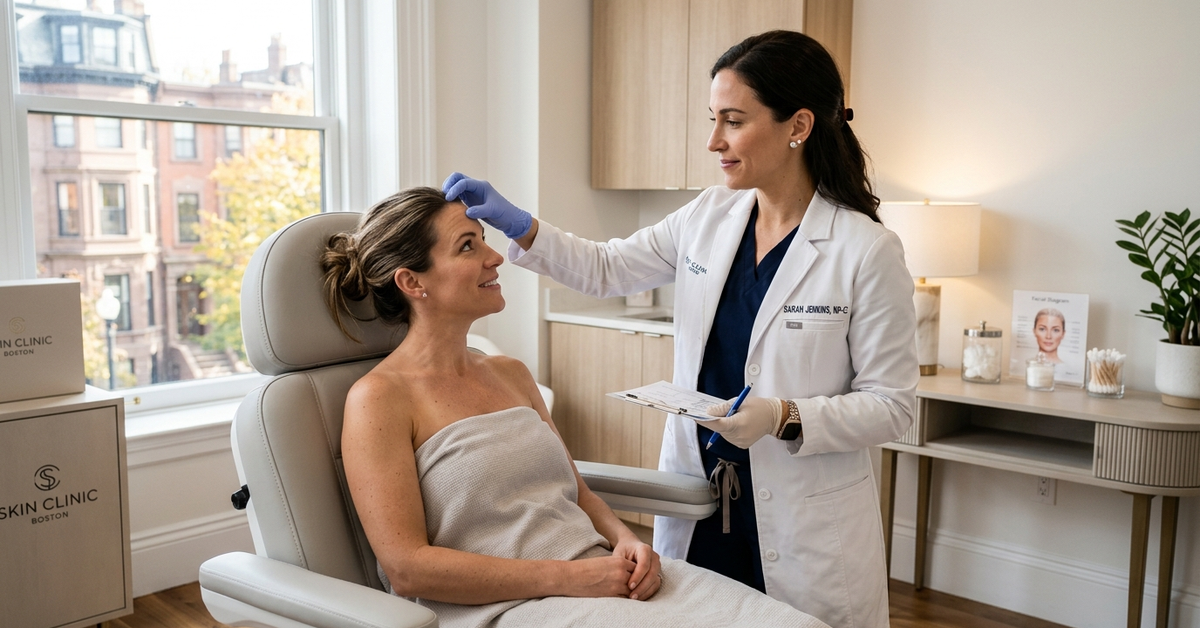
For the upper face, typical Botox dosing is about 20 units for forehead lines, 20 units for frown lines (the 11s), and 24 units for crow's feet — roughly 40 to 64 units to treat all three areas together. These are FDA-approved starting points; your exact dose depends on muscle strength and anatomy, not a clinic's pricing, and is confirmed at your consultation and two-week review.
"How many units of Botox do I need for forehead lines, frown lines and crow's feet?" is one of the most common questions patients ask during consultation. The right dose depends on your muscle strength, facial anatomy, and aesthetic goals. What follows is a clear picture of FDA-approved dosing ranges, typical practice ranges, and the factors that make your treatment personal. At our nurse-practitioner-led clinic in Back Bay, Boston, transparency about units builds trust, and informed patients get better results.
Quick Answer: Recommended Botox Units by Area
The table below summarizes FDA-approved doses and practical ranges from clinical practice. FDA-approved doses come from the BOTOX Cosmetic prescribing information, while practical ranges reflect how clinicians adjust based on individual anatomy and goals, as described in clinical practice guidance.
| Treatment Area | FDA-Approved Dose | Practical Range |
|---|---|---|
| Forehead lines (frontalis) | 20 units | 10 to 30 units |
| Frown lines (glabella / 11s) | 20 units | 15 to 25 units (up to 40 for strong muscles or men) |
| Crow's feet (both sides) | 24 units total (12 per side) | 10 to 24 units total (5 to 12 per side) |
| All three upper-face areas | 64 units | 40 to 64 units |
These ranges are general guidelines, not a universal prescription. A patient with strong frontalis muscles may need 25 to 30 units for the forehead, while someone with fine lines may need only 10 to 15. The unit requirement is determined by muscle mass and strength, not by a clinic's pricing model.
What Is a Botox Unit? Understanding the Basics
A Botox unit is a standardized measure of the biological activity of onabotulinumtoxinA. It quantifies how much muscle relaxation a given amount of product produces, calibrated through a specific assay method defined by the manufacturer. BOTOX Cosmetic is the branded formulation approved by the FDA for aesthetic use, not a generic term for all wrinkle relaxers.
Units are product-specific per FDA labeling. A unit of Botox is not equivalent to a unit of Dysport, Xeomin, or Daxxify. The FDA prescribing information states that BOTOX Cosmetic units "cannot be compared to nor converted into units of any other botulinum toxin products assessed with any other specific assay method." This is why comparing per-unit prices across brands is misleading. Dysport typically requires approximately 2.5 to 3 times the unit count of Botox for a comparable effect, so a lower per-unit price does not mean a cheaper treatment.
More units generally mean more muscle relaxation, but over-treatment can cause an unnatural or frozen appearance. A qualified injector determines the right number of units based on your facial anatomy and desired results, not a one-size-fits-all chart.
Botox Dosage by Treatment Area
The three primary upper-face treatment areas each involve different muscles and require different dosing approaches. Treating all three together is common and FDA-labeled at 64 total units. Many patients start with one or two areas, typically 20 to 40 units, for their first session before expanding to a full upper-face treatment.
Forehead Lines (Frontalis Muscle)
Horizontal forehead lines are caused by the frontalis muscle, which raises the eyebrows. The FDA-approved dose is 20 units split across five injection sites. In practice, the range runs from 10 to 30 units depending on forehead height, muscle strength, and line depth. First-time patients with lighter lines may start at 10 to 15 units; deeper, established lines may need 25 to 30 units.
A critical safety note: forehead Botox is almost always combined with glabellar treatment. The FDA label recommends treating forehead lines in conjunction with glabellar lines to minimize the potential for brow ptosis, which is drooping of the brow. Treating the forehead alone weakens the lifting muscle without addressing the depressors, which can cause the brow to drop.
Patients who want a lifted brow arch may need strategic placement rather than simply more units. The desired brow position influences dosing decisions as much as line severity does.
Frown Lines (Glabella / '11s')
Glabellar lines, the vertical "11s" between the eyebrows, are caused by the corrugator and procerus muscles. This is the most commonly treated area and the first cosmetic use FDA-approved for BOTOX Cosmetic. The FDA-approved dose is 20 units across five injection points: two in each corrugator muscle and one in the procerus.
The practical range is 15 to 25 units. Men or individuals with strong frown muscles may need up to 40 units. Dynamic lines, visible only during expression, often respond well to standard doses. Static lines, visible at rest, may require more units or additional treatment sessions to soften fully.
Precise placement matters. Injecting too close to the brow can contribute to brow ptosis or eyelid drooping. An experienced injector maps your muscle anatomy before placing a single needle.
Crow's Feet (Orbicularis Oculi)
Crow's feet, also called lateral canthal lines, are caused by the orbicularis oculi muscle around the eyes. The FDA-approved dose is 24 units total, 12 per side, with three small injections per side. The practical range runs from 5 to 15 units per side, or 10 to 30 units total, depending on severity and age.
The goal is to soften crinkling while maintaining a natural, warm smile. Over-treatment can flatten the smile and make expressions look stiff. Ranges may be quoted per side or bilateral, so always confirm which measurement a clinic is using before comparing quotes.
Factors Influencing Your Individual Botox Dosage
FDA-labeled doses are reference points, not a universal prescription. Every patient is unique, and several factors influence how many units you actually need.
- Muscle strength and mass: Stronger, larger muscles require more units to achieve the same relaxation.
- Gender: Men typically need 1.5 to 2 times more units than women across all areas due to larger, more powerful facial muscles.
- Age: Older patients with deeper, established lines may need more units, especially for static lines visible at rest.
- Metabolism: Some individuals metabolize Botox faster, requiring more units or more frequent treatments.
- Desired outcome: Patients wanting full immobilization need more units; those preferring natural movement, sometimes called "baby Botox," need fewer.
- Line severity: Static lines, visible at rest, versus dynamic lines, visible only during expression, require different approaches.
- Previous treatment history: Regular Botox users may need fewer units over time as muscles thin from disuse.
No online guide can replace a clinical assessment. A personalized consultation with a qualified injector is the only way to determine the right dose for your face.
Botox vs. Other Neurotoxins: Unit Equivalency and Differences
BOTOX Cosmetic is one of several FDA-approved neurotoxin brands. Dysport, Xeomin, Daxxify, and Jeuveau all use botulinum toxin type A but have different formulations, diffusion properties, and onset times. We offer FDA-approved wrinkle relaxers including Botox, Dysport, Xeomin, and Daxxify because different products suit different patient needs and preferences.
Units are not interchangeable between brands per FDA labeling. Dysport typically requires approximately 2.5 to 3 times the unit count of Botox for a comparable effect. Xeomin is "naked" botulinum toxin without accessory proteins, which may reduce antibody resistance. Daxxify is longer-lasting, with results extending up to 6 months compared to the typical 3 to 4 months for Botox.
Always confirm which product is being used when comparing prices or unit counts between clinics. A per-unit quote for Dysport and a per-unit quote for Botox are not apples-to-apples comparisons.
Safety, Side Effects, and Aftercare
Botox has a strong safety profile when administered by a qualified, licensed medical professional using FDA-approved product from authorized sources. Common side effects include temporary redness, swelling, or bruising at injection sites, and mild headache. Rare but possible side effects include brow ptosis, eyelid drooping, and asymmetry, which are usually temporary and resolve as the product wears off.
The FDA has warned about unapproved and misbranded botulinum toxin products, which is why we use only FDA-approved products sourced directly from manufacturers with full transparency. As noted by Krauss Dermatology, Botox "is a medical procedure and should not be performed at a salon, a party or someone's home."
Aftercare is straightforward but important. Avoid lying flat for 4 hours, avoid strenuous exercise for 24 hours, and avoid rubbing or massaging treated areas. Skip facials or saunas for 24 to 48 hours. A follow-up appointment at 2 to 3 weeks allows your injector to assess results and determine if additional units are needed.
The Importance of a Qualified Injector and Consultation
Your results depend heavily on injector skill and anatomical knowledge. The FDA prescribing information states that physicians administering BOTOX Cosmetic must understand the relevant neuromuscular and structural anatomy of the area involved. During a consultation, expect a facial assessment, a discussion of aesthetic goals, a review of medical history, and a personalized treatment plan.
Our consultation model is built on informed decision-making. We do not treat on consultation day unless you request it, which gives you space to think without pressure. Our zero-commission model means clinicians recommend only necessary treatments, never upsell. The same injector who plans your treatment performs it, ensuring consistency and a strong clinician-patient relationship. All treatments are documented with standardized photography and written plans provided to you. We are nurse-practitioner-led and physician-supervised, with board-certified clinicians committed to clinical standards and patient transparency, as described on our about page.
If you are exploring what natural-looking results mean for your specific facial anatomy, our guide on natural-looking Botox walks through how skilled injection technique preserves expression while softening lines.
Ready to find out exactly how many units of Botox you need? Book a personalized, no-pressure consultation at our Back Bay clinic. Your injector will assess your facial anatomy, discuss your goals, and build a written treatment plan tailored to you. No upselling, no treating on the same day unless you ask for it, and full transparency on every unit.
For more context on Botox treatments in our area, our complete guide to Botox in Back Bay, Boston covers what to expect from start to finish.
To explore our full range of aesthetic and wellness treatments, including skin rejuvenation and body contouring, visit our treatments page.
Interested in long-term savings on repeat treatments? Ask about our membership programs for ongoing aesthetic and wellness care, designed to make consistent treatments more affordable over time.
- FDA-approved doses are 20 units for forehead lines, 20 units for frown lines, and 24 units for crow's feet, totaling 64 units for all three areas.
- Practical ranges vary widely (10 to 30 for forehead, 15 to 25 for glabella, 10 to 24 for crow's feet) based on muscle strength, anatomy, and goals.
- Botox units are not interchangeable with Dysport, Xeomin, or Daxxify units per FDA labeling.
- Forehead Botox should be combined with glabellar treatment to minimize the risk of brow ptosis.
- A personalized consultation with a qualified, certified injector is the only way to determine the right dose for your face.
Frequently asked
Can I get all three areas treated at once?
How long do Botox results last?
What if I need more units after my treatment?
Is baby Botox an option?
How much does Botox cost per unit?

Dr. Bella Brooks is a medical aesthetics physician at Purely Medspa in Boston, focusing on facial aesthetics, injectables, treatment planning, and natural-looking aesthetic results.
Want your own number?
A free thirty-minute consult ends with a written map: your zones, your unit counts, and a total. No obligation to book anything.